
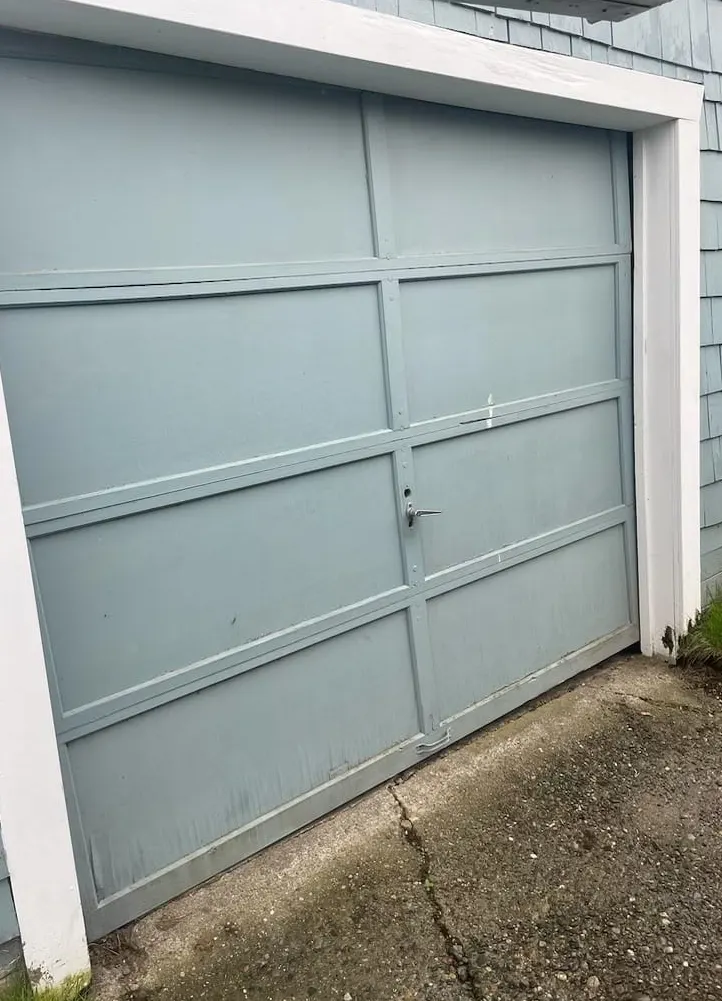
The Moment You See It
You pull into the garage, cut the wheel a little too sharp, and hear that dull thunk as the bumper kisses the bottom panel. Or maybe it was a bike, a trash can lid caught by the wind, or hail from one of those spring storms that roll through every year. Either way, you walk around the car, crouch down, and there it is: a dent. Now someone in the house wants it fixed today, and someone else thinks it's "just a dent" and can wait. Here's how to settle that argument with facts instead of volume.
Three Questions That Actually Decide the Answer
Not all dents are the same, and the right call depends on three things: where it is, how deep it is, and what the door is made of. Answer those honestly and most of the debate solves itself.
Where is it?
A dent in the flat field of a panel, away from the edges, hinges, and rollers, is usually cosmetic. A dent near a hinge, near the track side of a panel, or along the bottom seal is a different story — that's where the door actually has to flex and move, and damage there can throw off alignment even if it looks minor.
How deep is it?
Run your hand over it. A shallow crease you can barely feel, where the paint isn't cracked, is almost always surface-level. A dent deep enough to leave a visible shadow, crack the paint or primer, or create a sharp crease (not a smooth curve) is more likely to have stressed the metal itself.
What's the door made of?
This one matters more than people think, and it's worth checking before you argue about the fix.
- Steel panels (the most common type in this area) dent instead of cracking, which is good news — they can often be pulled or pushed back close to flat. But steel also work-hardens where it's been bent, so a panel that's been dented and re-dented in the same spot gets weaker each time.
- Aluminum panels dent more easily and don't spring back the same way steel does. A dent in aluminum is more likely to be permanent and visible even after a repair attempt.
- Wood or wood-composite doors don't really "dent" the way steel does — they crack, split, or compress the grain, which is a different kind of damage and usually not something to pull or hammer out.
When It's Just Cosmetic
A dent is cosmetic when it's shallow, away from moving parts, hasn't cracked the paint badly enough to expose bare metal, and doesn't change how the door opens or closes. In that case, this really is a "when we feel like it" job, not an emergency. The main reason not to ignore it indefinitely: if the paint is cracked, bare steel is now exposed to Cleveland-area humidity and winter road salt that gets tracked into the garage. A cosmetic dent today can become a rust spot by next winter if the finish is broken. Touch-up paint or a simple dent-pulling kit is often enough.
When It Affects Function
Some dents look minor but aren't, because of where they sit. A dent near the track can narrow the channel the rollers ride in, causing the door to bind, scrape, or run unevenly. A dent near a hinge can change the angle between two panels just enough that the door doesn't seal properly at the bottom — which you'll notice as a draft, daylight showing under the door, or the door working harder (and louder) than it used to. These aren't always obvious at a glance, which is exactly why they cause arguments: one person sees a small ding, the other notices the door isn't closing quite right anymore and connects the dots.
When It's Structural
A dent crosses into structural territory when it's torn the metal, buckled a seam between sections, bent a hinge plate, or pushed a panel out of square so the door no longer sits flat against the frame. Signs to watch for:
- The door looks slightly twisted or doesn't meet the floor evenly along its whole width.
- You hear new grinding or popping sounds when the door opens, especially near the dented section.
- The opener seems to strain more, reverses unexpectedly, or trips its safety sensors more often.
- A support strut (the horizontal reinforcement bar on the inside of many panels) is bent or has come loose.
Structural damage isn't a cosmetic fix. Pulling the dent won't restore the panel's strength, and a weakened section is more likely to fail under the stress of winter cold (metal gets brittle and less forgiving below freezing) or a strong spring wind event. In these cases the panel, not just the dent, is the problem.
A Quick Way to Settle It
Stand back and look at the door as a whole, not just the dent. If the door still opens smoothly, seals evenly along the bottom and sides, and the dent is a smooth shallow curve away from hardware, it's cosmetic. If the door hesitates, scrapes, lets in light, or the dent has a sharp crease near a hinge, track, or strut, it's worth a second opinion before anyone calls it "nothing."
When to Call Beachwood Garage Door Co
If you're not sure which category your dent falls into — or you already know it's affecting how the door moves — that's exactly the kind of call we're set up for. We'll check the panel, the track alignment, and the hardware around the dent, not just the dent itself, and tell you plainly whether it's a cosmetic fix or a garage door repair that calls for section or panel replacement. If the damage has knocked the door out of alignment enough to strain the motor, we'll also check whether opener repair is needed so you're not just patching the panel while the opener keeps fighting a door that isn't moving true.
If that dent has been the topic of dinner-table debate in your Beachwood, Shaker Heights, Pepper Pike, or Cleveland Heights home, give us a call. We'll take a look, tell you straight what it is, and fix only what actually needs fixing.