
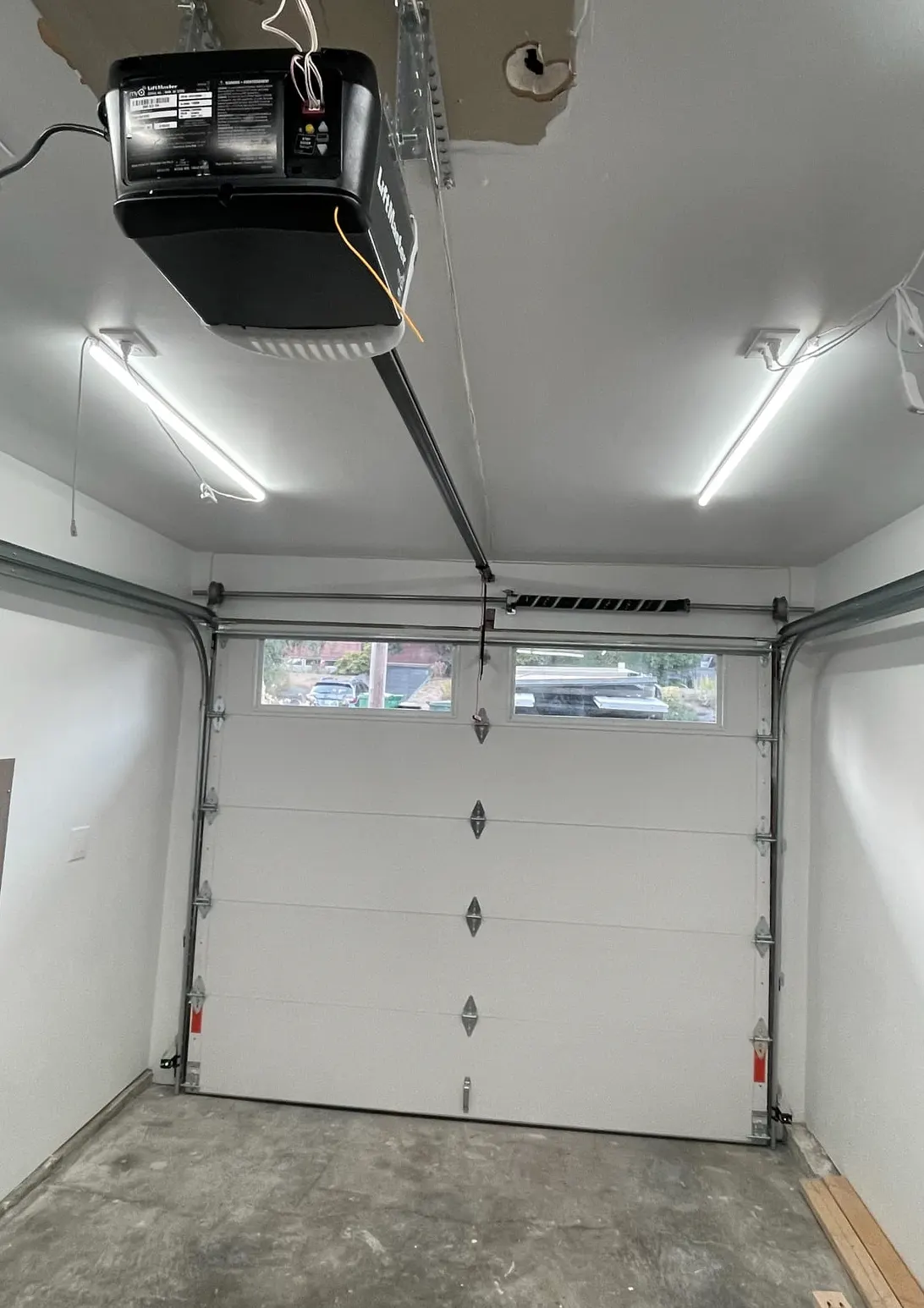
What a Technician Sees on This Call
The call usually comes in the morning after an ice storm knocked the power out overnight. One spouse is standing in the garage insisting the opener should have kicked over to battery power like it did at their parents' house. The other is pointing out the car is stuck inside and nobody mentioned a battery backup when the opener was installed. By the time our tech gets there, the argument isn't really about the door — it's about whether this was supposed to happen or not. So let's settle it with what the equipment actually does.
What a Battery Backup Actually Is
A battery backup is a rechargeable battery pack built into or added onto a garage door opener. When the power is on, it sits there trickle-charging. When the power cuts out, the opener switches over to the battery automatically, and you can still open and close the door with the wall button or your remote. It's the same idea as a battery backup on a sump pump — it's not there for everyday use, it's there for the moments when the grid isn't cooperating.
It does not mean the door opens and closes forever on battery power. Most units are rated for a limited number of cycles — often somewhere in the range of 10 to 20 open-close cycles — before the battery needs recharging or replacing. It's a bridge to get your car out or get it safely parked, not a permanent workaround for a power outage that drags on for days.
How It Works When the Power Goes Out
The moment utility power drops, the opener's control board senses the loss and switches the motor's power source to the battery. From where you're standing, nothing looks different — you press the remote, the door moves, the light might even still come on (though some units dim the light or skip it to conserve battery). What you won't get is Wi-Fi connectivity if your opener uses a smart hub that also lost power, so don't be surprised if the phone app doesn't respond even though the physical door still works fine.
Once utility power comes back, the opener switches back automatically and starts recharging the battery for next time. You don't have to do anything — no resetting, no manual override, assuming the battery itself is still healthy.
When It's Required vs. When It's Just a Good Idea
Here's where the argument usually gets resolved one way or the other. Many openers sold in recent years already come with a battery backup built in standard, largely because garage door openers are often the primary entrance people use to get in and out of their home — no battery backup means no way in if the power's out and the door is the only accessible entrance. If you bought a new opener recently, there's a good chance it already has this feature whether you asked for it or not.
If you have an older opener without one, it's not required after the fact — you're not out of compliance with anything by not retrofitting it. It comes down to how much it matters to your household:
- If the garage door is your only way in or out (no usable side door, or the side door is blocked by snow or ice most winters), a battery backup is more than a nice-to-have.
- If you rely on the garage to get a car out during storm season — and in this part of Ohio, spring storms and winter ice both tend to knock power out at inconvenient times — being stuck is a real inconvenience, not a hypothetical.
- If you have an easy, reliable side door and don't mind manually releasing the opener's trolley to lift the door by hand during an outage, you can skip it and save the money.
The Trade-offs: Cost, Maintenance, Lifespan
A battery backup isn't a one-time purchase and done. The battery itself degrades over time, especially with the temperature swings this area gets — hard freezes in winter and hot, humid summers both shorten battery life faster than a mild climate would. Expect to replace the backup battery every few years, not just set it and forget it. If it's been sitting unused and untested, don't assume it'll work the first time you actually need it during an outage; it's worth testing it occasionally by unplugging the opener and trying the remote.
Cost-wise, a battery backup unit (either built into a new opener or added to an existing one) is a modest add-on compared to the price of the opener itself — not a major expense, but not nothing either. Weigh that against how often you'd actually be stuck without one, given your garage's layout and how often your power goes out.
When to Call Beachwood Garage Door Co
If you're not sure whether your current opener has a working battery backup, or you've got an older unit and want to know what it'd take to add one, that's a quick thing for us to check during a standard opener repair and installation visit. We'll test the existing battery if there is one, tell you honestly whether it's worth replacing or upgrading, and walk you through options that fit your garage's setup rather than upselling you on something you don't need. If the real issue turns out to be the opener itself struggling in cold weather, that's worth a look too — sometimes what looks like a dead battery is actually a motor working harder than it should.
If you're in Beachwood, Shaker Heights, University Heights, Cleveland Heights, Pepper Pike, Lyndhurst, South Euclid, or Mayfield Heights and want a straight answer on your opener's backup power situation before the next storm rolls through, give Beachwood Garage Door Co a call. We'll check it, explain it in plain terms, and make sure you're not caught guessing next time the power goes out.